Showing posts with label KDR. Show all posts

Wednesday, 28 March 2012

Evaluation Question 4

Who are your audience?


Above is a sample survey carried out by a seventeen-year-old male that is a privately educated student, in their penultimate year of secondary school. Having questioned a fairly broad age range of people, I think it is safe to deduce that our target audience will be someone similar to the person questioned above. We aimed to dress our character in clothes similar to those of people our age, and his behaviour and dialogue were also supposed to be relevant to our audience.
Based on our collected data, I think that it is safe to deduce that our target audience fits comfortably into the 15-25 year-old category. They are most likely a student or young adult, probably either currently in higher education or entering/leaving higher education. Of the people that we sampled, the most complimentary and excited by our piece were most definitely people of a similar age to us. Although the themes of our piece would most likely encourage the diversion use and gratification, the actors we used were relatable to teenagers, meaning that personal identity could also be a reason for viewing our piece.
Although several films of similar genres to ours can be classified as 12 or 12A's, if we were conforming to the guidelines of the bbfc, we believe that some of the themes that we chose to include in our piece could be too violent for viewers younger than 15. When asked, the majority of our audience associated our piece with films such as Drive, Collateral, and The Bourne Identity. These films are all classified as 18’s or 15’s, suggesting that our original predictions were correct.


Evaluation Question 6

What have you learnt about technologies form the process of constructing this product?

Blogger.com – This was very useful for displaying our progress, planning, constructing and evaluation.

YouTube.com – We used this to research thriller openings, which helped inspire us. It was also used to display our preliminary task and our final piece.

Google.com – Arguably one of the most useful forms of technology, as it allowed us to search for and access images, music, and information about similar films for our research section.

Final Cut Pro X – This was used to construct our film, our recce and preliminary task, and also to edit them using things such as filters, titles, colour balancing, and sound balancing that were available with the software. For example, we used an expander to make sections of our dialogue clearer, and we used frame matching to equilibrilize the colour of certain shots. It also had a built-in automatic save feature, meaning that our work was less easily lost.

Apple Macintosh iMac desktop – I found this computer extremely easy to use, and the display was very clear, making editing easier, as we could see problem areas that required correcting.

Sony HD Camera – We used this to film our piece and our recce. We learnt how to use it whilst shooting our recce, and I found it easy to manipulate in order to achieve the necessary shots.


Tripods – We used this to steady the camera, and this in turn helped achieve key shots, such as the wide-angle opening shots of Tower Bridge and the surrounding areas.

Microphone – These were most definitely essential, as even though we had minimal dialogue, the lines that we did choose to include were very important for the audience to hear, therefore we used microphones.

Kaiser Video lights – We decided to include these, as some of our locations were badly lit and therefore required lights, but we also used them in naturally well-lit shots, as it created a better atmosphere, and helped reduce graininess.

Imdb – This was used a great deal to acquire information about directors, films, and production companies, it therefore contributed the most to the research and planning sections of our piece.

DaFont – We found the font that we chose to use in all our titles and the main title of our piece from this website, it was called ‘Bank Gothic’ and we felt it was distinguished from any of the fonts that could be found, both on Microsoft Word and Final Cut Pro X.

Free play music – We obtained the majority of our sound from this website, most importantly, our main music track, called ‘Ascension from the well’ by Peter John Ross. It was useful because it had a wide range of copyright free music.

I feel as though the thing that I have learnt the most about the technologies that we included is how to manipulate them in order to achieve the desired effect. In some cases, such as with Final Cut Pro X, I found it slightly harder to be fully confident with using it, but once I was competent enough, I felt as though it was a lot easier to create the final product that we had envisaged.


Thursday, 12 January 2012

Narrative for Thriller Opening

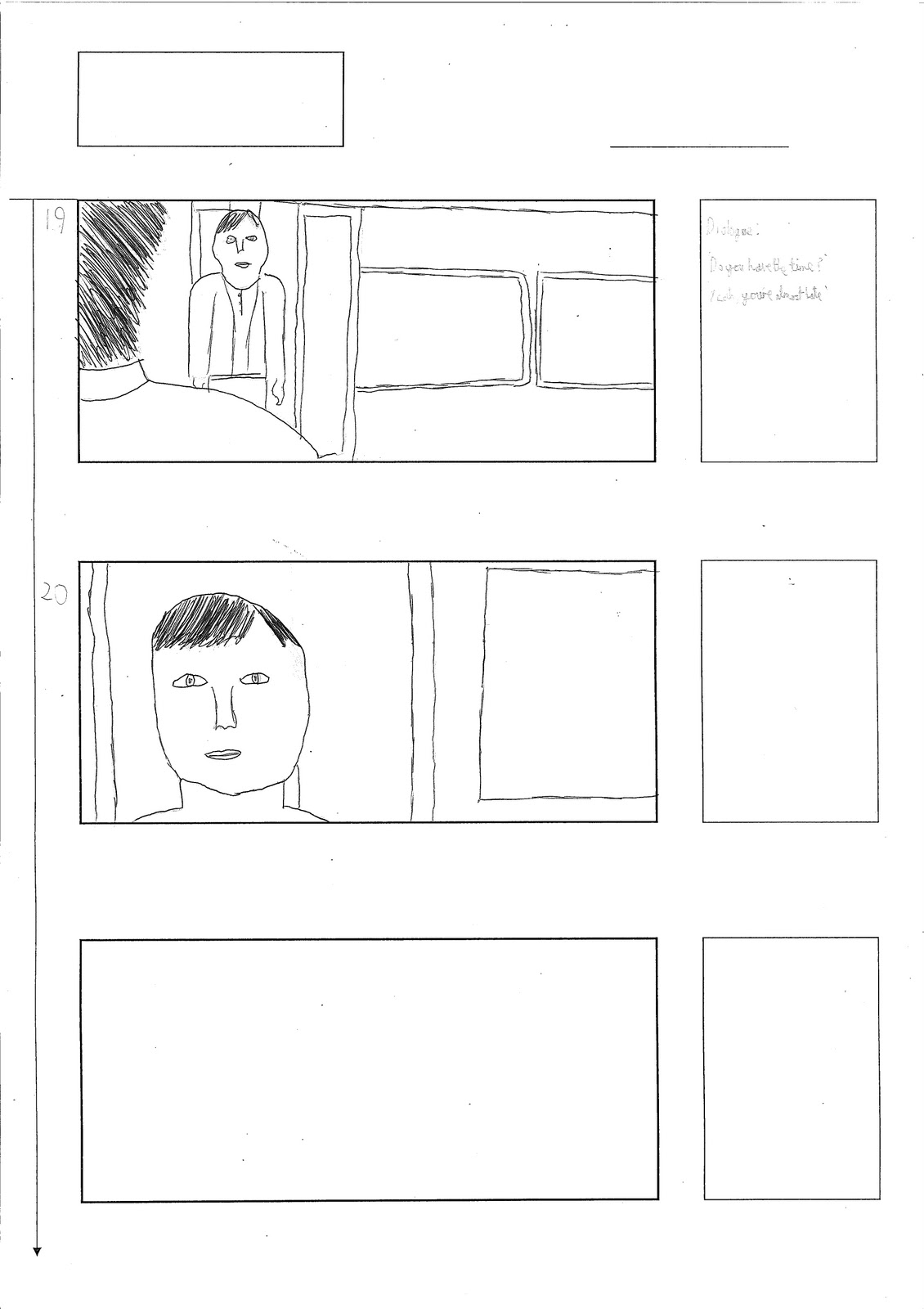
Screams are heard over a black screen, they get louder and bridge into the screeching of the DLR on the tracks. A man is sleeping inside one of the carriages, in the third row from the front. He wakes up and exchanges a few ambiguous words with an unseen stranger sitting next to him. This second character is never shown fully and remains a mysterious figure for the audience. The first character turns to look out of the window, and when he looks back, the man is gone. The train doors shut and the second character is shown leaving the train. The first character notices a book that has been left on the seat next to him by the mysterious man. He opens it and it contains a piece of paper with the name of the station where he presumes he is supposed to get off, consequently it is the one approaching. He exits the train and asks a man on the platform for the time, who replies ‘yeah, you’re late, red hat’ suggesting he isn’t a stranger and is fully aware about what is going to happen. The first character looks around the platform, and turns back to the man, who is already gone. He then notices three men leaving the station, one of which is wearing a red arsenal hat. He also notices a young girl, mid-teens, wearing a red hat, leaving the station. He takes his chances and decides to follow her. She doesn’t realise and walks on; it is getting darker by the minute. She crosses a dark street and the man drags her down an alley. The screams from the beginning are played again, and the screen fades to black.

Storyboard


Order of Shooting


  1. Shot 5
  2. Shot 2
  3. Shot 4
  4. Shot 3
  5. Shot 8
  6. Shot 9
  7. Shot 12
  8. Shot 10
  9. Shot 11
  10. Shot 13
  11. Shot 14
  12. Shot 15
  13. Shot 16
  14. Shot 6
  15. Shot 7
  16. Shot 17
  17. Shot 18
  18. Shot 19
  19. Shot 20
  20. Shot 21
  21. Shot 22
  22. Shot 24
  23. Shot 23
  24. Shot 25
  25. Shot 26
  26. Shot 28
  27. Shot 29
  28. Shot 27
  29. Shot 30
The shot labeled 1 should be filmed first, as it contains the area surrounding the DLR journey. The shots numbered 2 to 12 should then be filmed together as they take place on the DLR itself. Shots 13 to 16 should also be filmed together as they occur on the platform. The rest of the shots, with the exception of the ones numbered 22 and 23, should then be filmed in chronological order.

Cast


The character of the young teenage girl will be played by Alice Alphonse. We have chosen her because we believe that she has the most physical resemblance to the character we imagined in our heads


For the role of the murderer we have chosen Callum as we believe he could portray his character very well.


For the role of the man on the platform, we have chosen Gus Grant, due to the fact that he will physically resemble the character we had in mind a lot.


For the part of the mysterious man on the train, we have chosen Ollie Brenmann because he has acting experience with roles such as this one.

Shooting Schedule

  • We will be meeting at 3pm outside Canary Wharf Station.
  • Christoph is responsible for collecting the equipment from school and bringing it to location on Saturday.
  • We will be filming our piece in chronological order, as the scenes take place at different times of evening, and therefore natural light will change as the piece progresses.
  • If it is raining we will film regardless, but take necessary precautions to protect the equipment.
  • I envisage our filming time to last around 2 to 3 hours, but our reccee to last slightly longer, to ensure we are prepared.
  • Every crew member has the telephone numbers of both other crew member and the cast members, which can be used in the event of an accident or tardiness.
  • In the event of illness or emergency unavailability of a cast member, we will proceed to film the scenes which they are not in, and either find a suitable replacement, or film their scenes at a later date. 
  • In the event of illness or emergency unavailability of a crew member, the other crew members will proceed to film the piece regardless.